
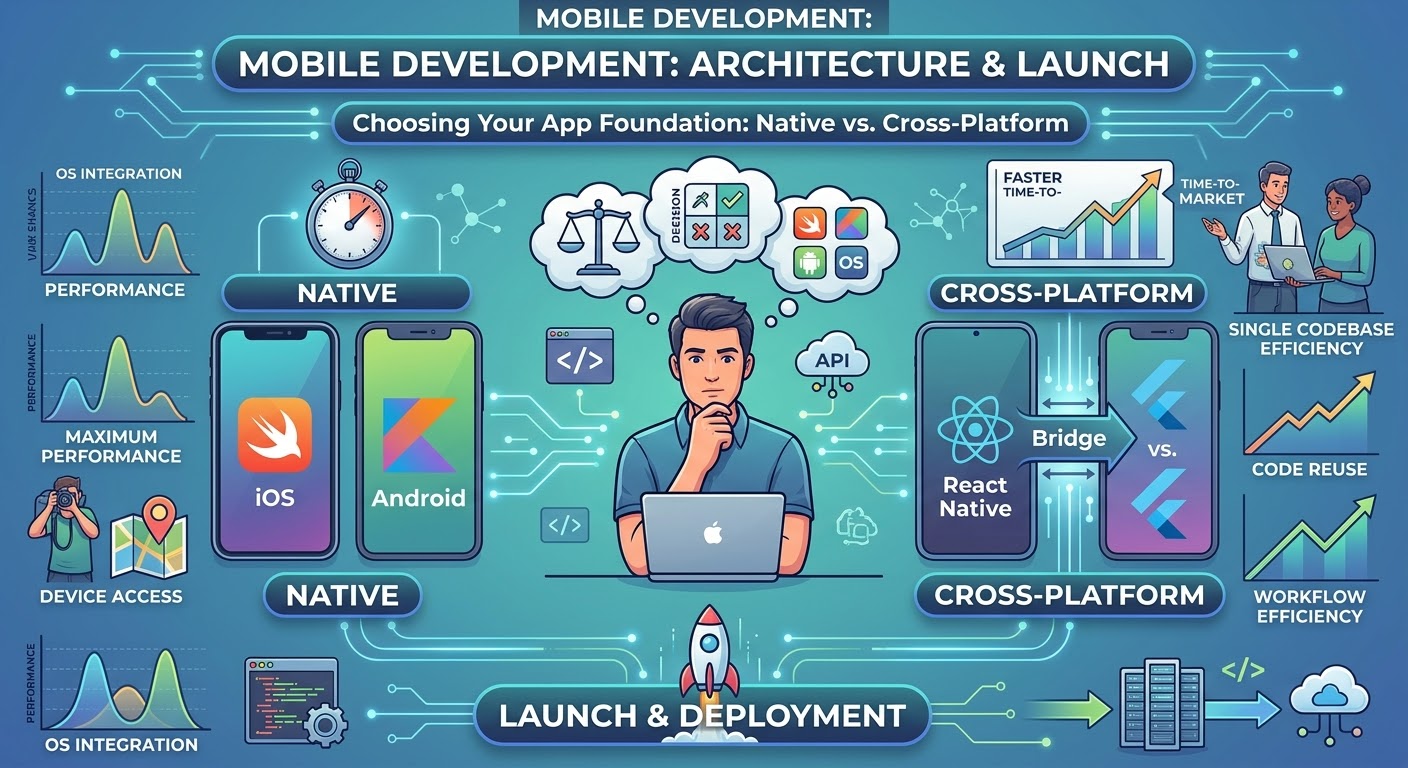
When bringing a new mobile application to market, engineering leaders face a foundational architectural dilemma: Should you build natively, or utilize a cross-platform framework?
Your decision directly impacts your initial development timeline, budget allocations, performance limits, and long-term codebase maintenance. To guide your architectural choice, let’s break down how Native development compares against modern cross-platform solutions.
The Landscape At A Glance
Metric
Native Development (Swift / Kotlin)
Cross-Platform (React Native / Flutter / Unity)
Codebase
Dual codebases (separate for iOS and Android)
Single unified codebase across platforms
Performance
Maximum; direct hardware acceleration
Near-native; minor overhead for complex rendering
Time-to-Market
Longer (requires parallel development)
Significantly shorter
Access to APIs
Instant access to new OS features
Dependent on third-party bridge libraries
When to Choose Native Development
Native builds (using Swift for iOS and Kotlin/Java for Android) offer raw, uncompromised access to the underlying hardware ecosystem. Choose native if your application requires:
- Heavy graphic processing, complex multi-threading, or high-performance mobile gaming.
- Deep integration with device-specific hardware components like advanced camera APIs, custom Bluetooth peripherals, or low-level background processing.
- Strict compliance with platform-specific UI patterns and micro-animations.
When to Choose Cross-Platform Frameworks
Cross-platform development allows teams to deploy to both app stores using a single shared codebase. This is highly advantageous if:
- You are launching an MVP or working within tight financial constraints.
- The application relies heavily on standard RESTful APIs, data management, and predictable user interfaces.
- You need to maintain feature parity between your iOS and Android user base simultaneously.
The Bottom Line
If absolute performance and deep hardware hooks are central to your business model, invest in native architecture. For the vast majority of consumer-facing, data-driven utility applications, cross-platform tools offer a massive advantage in speed and efficiency.
Launch Your Mobile App Effortlessly
Whichever development route you take, you don't have to start with a blank canvas. Discover production-ready Android and iOS App Templates on OrdSpell, ranging from native codebases to Unity projects, designed to fast-track your launch.
Comments (0)